
The Lone Giant: the Legacy of Strength
A Desperate Time for “The Lone Giant"
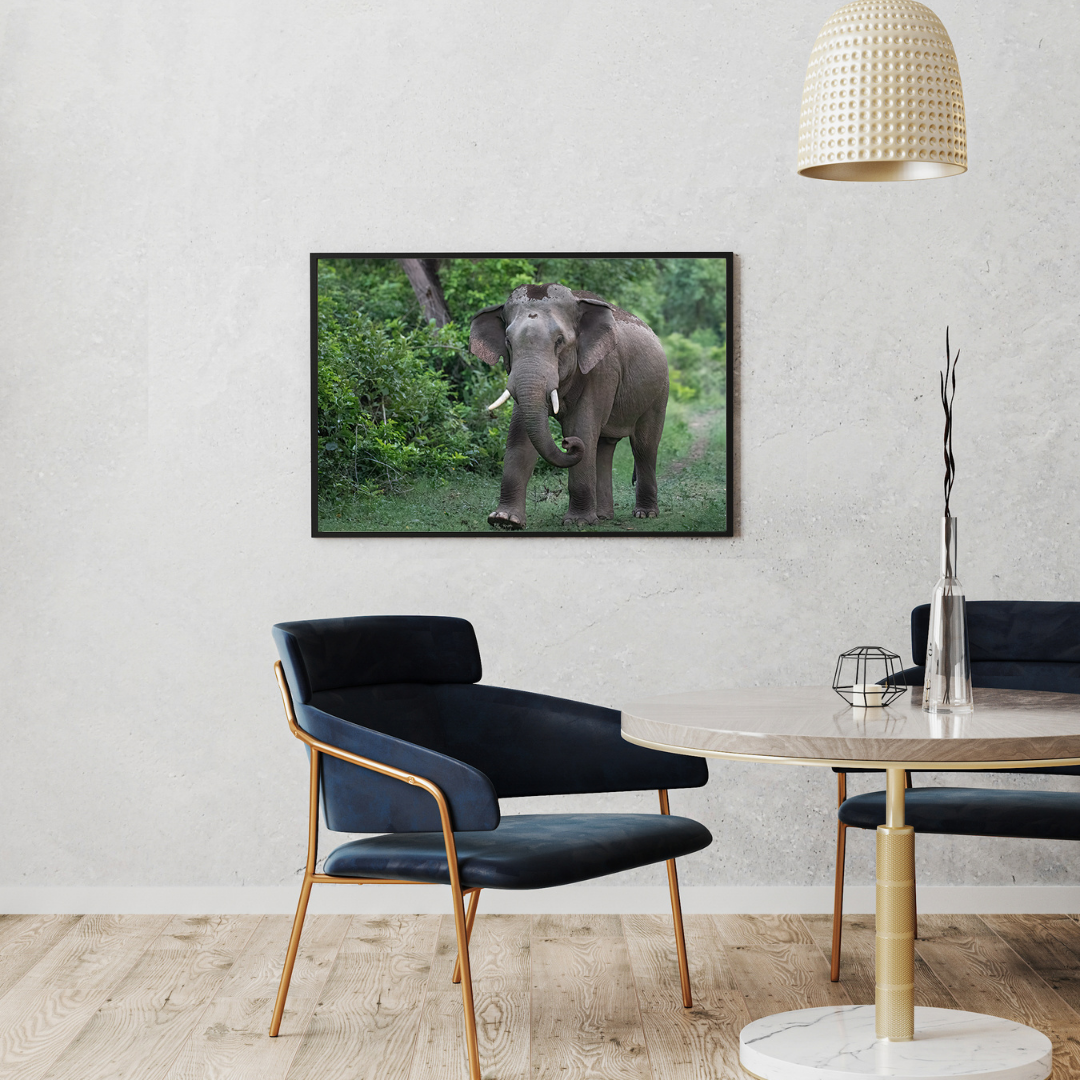
On that warm afternoon in Corbett, I met an elder named “Lal Kan.” He moved with a patience carved by decades of survival, his tusks each weighing over good pounds—a living archive of evolution now on the brink. Through my camera, I hoped not just to document him, but to ask a question of us all: Will we ensure giants like him still walk this earth?
I admit it. I shed a tear as I raised my camera on a recent visit to Corbett, not knowing if I would see this magnificent soul, nicknamed “Lal Kan,” ever again. With his gentle demeanor and eyes making contact as if a plea for help, I saw in him another Earthling who did not know where else to turn.
Home Gallery—Where Art Tells a Story
Framed Print Display

Imagine our world without elephants? Frankly, this is not a vision I can even begin to ponder, for these great lumbering creatures are one of the reasons why natural wonder still fills my heart. Once upon a time, as late as the 1700s, historians and wildlife scholars estimate there were perhaps as many as 100,000 Indian elephants roaming the subcontinent — from the terai grasslands of the Himalayan foothills to the dense sal forests of what we now call Corbett. Within a century and a half, that number had collapsed catastrophically, mirroring the decimation of tigers in the same landscape, ground down by the twin forces of colonial hunting and the relentless shrinking of wild land. Today, roughly 27,000 to 30,000 wild elephants remain across India, and even this figure is misleading because it cloaks a reality liable to take the breath away: the great tuskers of Corbett — those magnificent bulls whose ivory curved long and heavy toward the earth, once the pride of the Ramganga valley — have been nearly erased from memory, hunted with cold precision for their tusks, their bones left in the tall elephant grass while their ivory traveled quietly into the hands of poachers and black market dealers far beyond these forest boundaries.
As a wildlife photographer, I do not possess much power or influence myself, but I try to inspire change by inviting you, the viewer, to join me in sounding an alarm and raising conscious awareness. These are desperate days and we need to place the plight facing Super Tuskers, like this beloved bull, before as many as we can.
Family Room—Light of Hope
High Definition Wooden Print

This photograph, which I have titled “The Lone Giant - Lal Kan,” shows this nearly 25-year-old elder in his full dignified glory as he strolled through the botanical brushlands of Corbett.
Fewer than 30 Super Tuskers still haunt the ancient pathways of their ancestors in the vicinity of the Corbett ecosystems. But time is running out. Their plunder by greedy ivory hunters has nearly eliminated their genetic bloodlines, which produced giants whose long trunks literally stretched to the ground. Vaunted even by their own kind, these mighty remnants desperately need our voice.
Business Office—Strength in Stewardship
Framed Wooden Display

“Fewer than thirty Super Tuskers still haunt the ancient pathways of their ancestors,” I wrote soon after capturing One Lal Kan Last Stand. These beings are living testaments to what endurance looks like in the face of unrelenting odds. Through this image, my hope is simple: that awareness will spark protection, and protection will give rise to generations yet unseen.
Reading Nook—Moments of Reflection


Written by WILDGRAPHY ADVENTURES


Leave a comment
This site is protected by hCaptcha and the hCaptcha Privacy Policy and Terms of Service apply.