
Article: Where the King Still Roams: My Soul-Stirring Safari at Gir National Park
Where the King Still Roams: My Soul-Stirring Safari at Gir National Park
March in Gujarat. Dust in the air. A jeep engine growling to life at 5 AM. And somewhere in the golden grassland ahead — a roar that stops your heart.
The Last Kingdom on Earth
There is one place on this planet where you can look a wild Asiatic lion in the eye and feel, with every cell in your body, that you are no longer at the top of the food chain. That place is Gir National Park, tucked into the Saurashtra peninsula of Gujarat, India — and it is nothing short of magical.
Gir is the last remaining refuge of the Asiatic lion, a subspecies that once roamed from Greece to the subcontinent. Today, fewer than 700 of these magnificent creatures exist — and every single one of them lives here. That number, fragile and precious, makes every sighting feel like a gift from the wild world itself.
I went in March, and I am still not the same person who left.
Arriving at the Edge of the Wild
I reached Sasan Gir the evening before my safari, and the place already had a heartbeat. The air smelled of earth and dry teak leaves. Langurs hopped across rooftops. A peacock dragged its tail across the road with the indifference of royalty.
I stayed at a forest lodge where the electricity was unreliable and the stars were not. Lying on the charpoy that night, I could hear the distant call of a nightjar and, once — just once — something that made the lodge dog whimper and curl tighter under the bed. Whether it was a lion or my imagination, I chose to believe the former. Sleep came slow and sweet.
Before Dawn: The Jeep, the Dust, and the Butterflies
Safari permits for Gir are notoriously hard to get. The Forest Department limits the number of vehicles that enter each zone daily, and for good reason — this is not a zoo. This is a living, breathing ecosystem and the animals are not performing for you. You are entering their world, on their terms.
My jeep was ready at 5:15 AM. The guide, a quiet man named Kamlesh who had spent 18 years inside Gir's forest, said four words before we entered the gates:
"No noise. Only eyes."
The forest at dawn is a different universe. The canopy filtered the first light into thin golden shards. Spotted deer — chital — stood absolutely still in the mist, their ears swiveling like satellite dishes. A pair of Malabar pied hornbills argued loudly in the treetops. A marsh crocodile, ancient and unbothered, lay on a muddy bank like a philosopher with no questions left.
And then Kamlesh raised his hand.
We stopped.
The Moment Everything Stopped
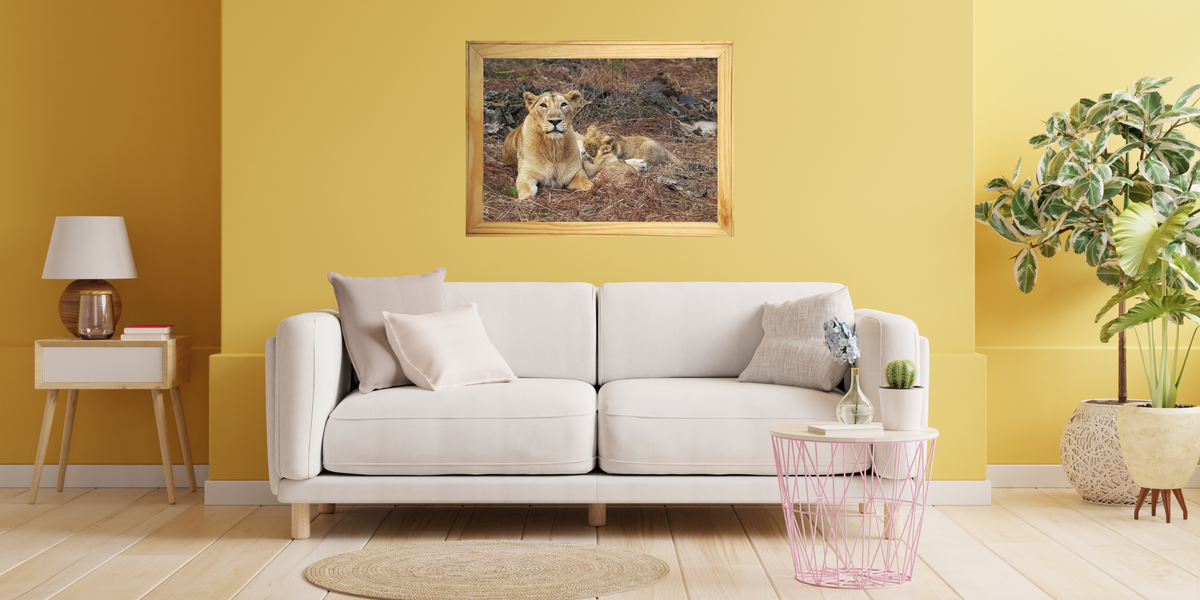
She was lying beneath a cluster of flame-of-the-forest trees, their orange flowers scattered like embers around her. A lioness. Full-grown, unhurried, impossibly calm. Her amber eyes turned toward us — not in fear, not in aggression — but in the quiet, absolute authority of something that has never been prey.
I forgot to breathe.

She held our gaze for what felt like a full minute, then looked away, as if she had decided we were not worth the energy. That dismissal was the most thrilling thing I have ever experienced.
"She has cubs nearby," Kamlesh whispered. "She is checking if we are a threat."
A mother. A queen. A guardian.
I have seen lions in documentaries, in photographs, in wildlife books. Nothing — nothing — prepares you for the weight of their presence in real life. There is an electricity in the air around them. The entire forest quiets. Even the birds seem to hold their breath. You understand, in your bones, why ancient civilizations put the lion on every crown, every flag, every temple gate. You understand why we have worshipped them for ten thousand years.
The Pride: A Morning That Rewrote Me
The second morning was even more extraordinary. Kamlesh had received word from another guide — a pride had been spotted near the Hiran River bank. We drove there in the pale blue light of early morning, and what we found made three of us in the jeep cry without warning or shame.
A male lion — massive, black-maned (Asiatic lions have shorter manes than their African cousins, but this one was exceptional), lazing on a flat rock by the riverbank. Around him: two lionesses and four cubs, no older than four months, tumbling over each other with the exact energy of kittens. One cub climbed onto the male's back. He twitched his ear. The cub fell off. Tried again.
The male exhaled — a long, low sound that vibrated in your chest — and put his enormous head back down.

A family. A dynasty. A story older than civilization.
We watched for forty minutes without a word. My notes from that morning consist of a single line: "I will never forget this as long as I live."
More Than Just Lions
Gir is not only a lion sanctuary — it is one of India's most biodiverse ecosystems, and March is peak season for wildlife viewing before the monsoon closes the park.
In three days of safaris, I also encountered:
- Leopards — ghostly and secretive, spotted twice in the thick undergrowth
- Jungle cats and Indian foxes trotting across the jeep trail at dawn
- Hyenas — often underestimated, always fascinating — near a dry riverbed at dusk
- Over 300 species of birds, including the paradise flycatcher with its impossibly long white tail streaming behind it like a silk ribbon
- A massive python coiled in a tree, doing what pythons do — absolutely nothing, magnificently
- Thousands of chital, sambar, and nilgai that form the base of Gir's thriving food chain
The forest itself is a patchwork of dry deciduous teak, acacia scrub, and riverine grasslands — beautiful in its own right, especially in March when the flame trees are in full orange-red bloom and the light is warm and golden before the summer heat sets in.
The Conservation Story: A Comeback Worth Celebrating
Here is a fact that should fill you with hope: In 1913, there were fewer than 20 Asiatic lions left on Earth. The species was on the absolute brink of extinction, hunted to near-oblivion by colonial-era sport hunting and habitat loss.
Today, thanks to one of India's greatest conservation success stories, there are over 670 lions in and around the Gir ecosystem. The credit goes to the Gurdas of the Junagadh kingdom who protected Gir in the early 20th century, the Forest Department of Gujarat, local communities like the Maldharis (traditional cattle-herders who co-exist with lions), and decades of patient, dedicated wildlife management.
This is what happens when humans decide that a species matters. This is what is possible.
Walking out of the forest on my last evening, I felt an almost unbearable gratitude — for the lions that survived, for the people who fought for them, for the thin green thread of wilderness that still holds.
Practical Notes (For When You Go — and You Must)
- Best time to visit: December to March. The park closes from mid-June to mid-October for monsoon season.
- Book permits early: Gir safari permits are available on the Gujarat Forest Department's official website and sell out fast, especially for weekends.
- Zones: There are six safari zones. Zones 1, 2, and 3 (around the core area) offer the best lion sightings. Ask your lodge to help you secure these.
- Stay: Several eco-lodges and forest resorts in Sasan Gir offer comfortable stays. Book well in advance for March.
- Respect the rules: No plastic inside the forest. No loud noises. Stay in the vehicle at all times. These are non-negotiable — and they exist for both your safety and the animals' wellbeing.
A Final Word
I came to Gir to see lions.
I left having understood something larger — that wilderness is not a backdrop. It is not a tourist attraction. It is the original world, the world that existed before us and will, if we are wise and humble enough, exist long after. The lions of Gir are not there for our entertainment. They are there because, for once, we got out of the way and let them be.
Go to Gir. Sit quietly in the jeep. Let the forest breathe around you.
And when the lion looks at you — really looks at you, with those ancient amber eyes — let yourself feel it. The smallness. The privilege. The love.
Because if you love them enough, you will protect them. And that is the whole point.
A handful of pieces from this trip are available — for walls that deserve more than décor. Take a look if you're curious.

Ecrit par WILDGRAPHY ADVENTURES

Laisser un commentaire
Ce site est protégé par hCaptcha, et la Politique de confidentialité et les Conditions de service de hCaptcha s’appliquent.